FLYDE

Category: Artificial Intelligence

Banner image for new product feature BRAIN blog post

We’ve launched Brain, an AI copilot that brings natural language capabilities to the FLYDE Customer Data Platform. You can now ask questions and get answers directly from your data without needing SQL knowledge or waiting on technical teams.

Ask Brain your questions in natural language. Get actionable answers based on your real business data.

With Brain, you can create datasets, build audiences, analyze results, generate reports, and make strategic decisions powered by predictive intelligence, all by writing in natural, conversational language. Brain also helps you ask better questions, deepen analysis with suggested follow-ups, prepare presentations instantly, and collaborate seamlessly across teams.


BRAIN IN CORE: GENERATE DATASETS WITHOUT WRITING SQL

Core is FLYDE’s app for data storage, conversion, and transformation. It is where you connect data from different sources, consolidate everything into one place, and build the datasets that power your marketing decisions. Historically, creating datasets has required technical knowledge, writing SQL queries, or waiting for your IT team.

Brain changes that entirely.

When creating a dataset in Core, simply describe what you need in plain language; fore xample, “I want sales by user and loyalty points.” Brain interprets your request and automatically generates the SQL query needed to build it.

This enables marketing and business teams to work independently, dramatically shrinks turnaround times, and accelerates data exploration. SQL generation democratizes advanced analytics, allowing more team members to work directly with data.


BRAIN IN MARKET: CREATE AUDIENCIES AND ANALYZE BEHAVIOR

Market is FLYDE’s audience activation and management application. It’s where you build customer segments that fuel your campaigns, activate them across channels, and understand their behavior.

With Brain in Market, you can create new audiences using natural language instead of manually applying filters. Describe what you need and Brain translates it into the appropriate filter logic.

Example: A bookstore has overstock of the novel, A Hundred Years of Solitude, by Gabriel García Márquez and wants to run a targeted promotional campaign via email. Rather than manually configuring filters, you can tell Brain: “Create an audience of customers who are likely to buy A Hundred Years of Solitude and opted in to promotional emails.” Brain generates the audience in seconds, and explains the logic to you, every step of the way. 

Brain can also analyze your audiences and propose strategic opportunities for action. You can ask follow-up questions directly within reports to understand behavior and surface additional insights.

Example: You have an audience of high-churn-risk customers. You say to Brain: “Analyze the main characteristics of my clients who show strong signs of churn and help me figure out how to retain them.” Brain analyzes the data and identifies key behaviors and characteristics as well as recommended next steps.

MARKET TALKS: ADVANCED ANALYTICS CONVERSATIONS

Market Talks is FLYDE’s advanced analytics application. While Market focuses on audience creation and activation, Market Talks is where you explore the metrics most relevant to your business, such as sales, channel performance, segment behavior, and revenue trends.

If you say to Brain, “Give me an in-depth analysis of purchases by channel for the last year,” Brain will deliver detailed insights, strategic interpretation, downloadable charts, improvement recommendations, and suggested A/B tests based on findings.

Need to present findings to leadership? Ask Brain to generate a downloadable PowerPoint presentation with key insights.

You can also save your conversations with Brain using custom names, organize them in folders, and share with teammates. Analysis becomes a collaborative asset.


BRAIN GUIDES YOU TO DEEPER ANALYSIS

One of Brain’s most powerful features is offering automatic suggestions for follow-up questions. After you complete an analysis, Brain proposes new paths of exploration based on patterns in your data.

After analyzing sales by channel, Brain might suggest: “Want to compare margin by channel? See how this compares to last year? Understand which segments are driving most of your growth?”

This system combats shallow analysis and interpretation bias. Instead of stopping at the first answer, Brain guides you deeper, acting as a thinking partner that drives a more mature analytical culture.

The impact on your business is direct: better-informed decisions, discovery of hidden opportunities, early detection of risks, and stronger alignment between data and strategy.


THE CONVERSATIONAL APPROACH

Brain works consistently across Core, Market, and Market Talks. You describe your data needs in Core. You create and analyze audiences in Market. You run advanced analytics in Market Talks. The same conversational approach can be used everywhere.

This reduces friction when moving between analysis and action. You stay in a natural language workflow instead of switching between interfaces, languages, and tools.


GETTING STARTED WITH BRAIN

Brain is live across Core, Market, and Market Talks. Start using it on your next dataset creation, audience build, or analysis.

Brain can also integrate directly with your existing ecosystem to provide an intelligent layer of analysis with a conversational approach over business data without changing your data infrastructure. Contact us if you would like to see a demo of Brain in action.


Banner image for blog post about FLYDE Talks 4

In the fourth episode of FLYDE Talks, Paco Herranz, founder and CEO of FLYDE, spoke with Álvaro Pariente, data and enterprise technology expert and founder and CEO of BEOC9, to analyze the key factors that will determine business success this year. The conversation explored crucial topics such as how to organize data, the role of CDPs (Customer Data Platforms), and why many companies are not seeing real results from artificial intelligence.


THE CRITICAL TRIANLGE: BUSINESS, DATA AND IT 

Álvaro began by highlighting a structural issue affecting many organizations. For years, companies have been digitizing processes and collecting data across multiple systems. However, this transformation created a problematic divide between three departments that should be working together:

  • IT: decides on architecture and systems
  • Business: defines the “what” and how to impact the customer
  • Data: often scattered between IT and business, with no clear owner

The result is predictable: data silos, lack of coordination, and multiple departments engaging the same customers as if they were entirely different companies.

The solution is not technological but rather organizational. Before investing in tools or implementing AI, companies need to align these three pillars internally and give them equal importance. Only then can they extract real value from their data.


THE REAL PROBLEM: ATTRIBUTION AND FRAGMENTATION 

A perfect example of this lack of organization is conversion attribution. When multiple departments interact with a customer through different channels (paid media, email, etc.), each one claims the conversion as its own.

The problem becomes even more troublesome in fast-growing companies that are investing aggressively in acquisition, because proving the return on each channel is critical.


THE EVOLUTION OF CDPs

Álvaro explained how the market has evolved from MDM systems (Master Data Management) to the new generation of CDPs. MDM systems required long projects, complex integrations, and the creation of a centralized “Golden Record” that often became invasive for existing systems.

Modern CDPs offer a different approach:

  • Less intrusive: they connect to existing systems without disrupting operations.
  • Continuous data collection: they unify data from multiple sources in real time.
  • Identity resolution: they build a single customer view without requiring a centralized record.
  • Fast activation: they allow immediate use of that information in the right channels.
  • Compatibility with your tools: they do not require a single-vendor infrastructure and can connect with Adobe, Salesforce, Braze, or other tools.

Paco emphasized the importance of this point: no single vendor can cover every use case a business needs.


THE UNCOMFORTABLE TRUTH ABOUT AI

This was the most critical point of the conversation. Álvaro was direct:

“Without data organization and data scale, AI, in my view, will not take you anywhere.”

The problem is not the AI model. The problem is the data.


WHY MANY COMPANIES ARE NOT SEEING RESULTS WITH AI

ChatGPT works because it has access to a massive encyclopedia of information on the internet. But when a company wants to apply AI to its business, it is not querying the internet. It is querying its own internal data.

And that is where things become complicated:

  • If your data is not organized
  • If your prompt is poorly structured
  • If your systems lack coherent information
  • If your data is fragmented into silos

The result will not be what you are hoping for, no matter how much money has been invested in sophisticated technology.

The companies seeing real value from AI all share one thing in common: they organized their data first (customer information, internal processes, organizational knowledge), and only then applied technology. Not the other way around.


AN EXAMPLE: SENTIMENT ANALYSIS

Paco shared a concrete case: a company with millions of customer interactions whose only measure of satisfaction was sending Net Promoter Score (NPS) surveys, which most people do not respond to.

The solution is clear if the data is organized: run those conversations through AI-powered sentiment analysis. The company already has all the information needed to determine whether a customer is happy, frustrated, or about to leave a negative review.

No new data is required. The data is already there. The only missing piece is applying the right technology on top of a well-organized data foundation.


SECURITY AND GOVERNANCE: NON-NEGOTIABLES

A critical point was emphasized: you cannot send private company data into a public LLM without proper safeguards. Doing so would expose employee and customer data.

The solution is to use models (OpenAI, Anthropic, Google) within a secure architecture that includes:

  • Data governance policies
  • Access control
  • GDPR compliance in Europe
  • Clear management of what data is served, what is exposed, and what is received


IMPLEMENTATION STRATEGY

The conversation also addressed how implementation timelines have changed. Álvaro was clear: 18-month projects are a thing of the past.

The strategy that works today is:

  1. Focus on one single use case (not seven)
  2. Implementation in a maximum of 2 to 3 months
  3. Measurable impact on a specific KPI (churn, lifetime value, RFM)
  4. Iterate and expand once value is proven

This approach has clear advantages:

  • Reduces time and costs
  • Makes ROI traceable
  • Drives adoption and change within teams
  • Results improve exponentially with each new use case

As Álvaro said: “If consulting doesn’t deliver value, and value is tied to KPIs, then we shouldn’t be there.”


THE GARTNER MAGIC QUADRANT

The conversation closed with an analysis of the recent Gartner Magic Quadrant for CDPs (2026), the third report since the category was created in 2024.

Key trends identified include:

  1. Expansion beyond marketing: CDPs are no longer only for segmentation and campaigns. They are increasingly being used for B2B use cases, customer service, sales, and operations.
  2. Composability as the standard: the ability to integrate with multiple systems without requiring a full single-vendor suite is becoming a baseline requirement.
  3. AI and natural language access: platforms that allow users to query data using natural language are enabling business users (non-technical teams) to extract insights without needing SQL.
  4. The importance of connectors: competition is being defined by the speed and quality of integrations. It is no longer acceptable for a connector to take three months when it should be as simple as “pushing a button.”


CONCLUSIONS: A ROADMAP FOR COMPANIES THAT WILL WIN IN 2026

The main lesson from FLYDE Talks Episode 4 is clear: the companies that integrate data, technology, and business strategy will be the true winners in 2026.

It is not about having the most advanced AI model. It is about:

  1. Organizing your internal structure so data, IT, and business teams work together
  2. Implementing a CDP that unifies information without being invasive
  3. Applying AI to your own data with proper governance and security
  4. Starting with specific use cases that prove ROI quickly
  5. Scaling iteratively

The question every company should ask is not “What new tool do I need?” but “How do I make my current investment deliver more value?”


HOW FLYDE CAN HELP

Is your company’s data ready for AI? At FLYDE, we will continue driving conversations that help organizations understand this new landscape and take advantage of AI within a secure, results-driven framework. Contact us to explore how you can leverage new technologies within your company.

Is your company ready for AI? Thumbnail for blog post with AI-readiness checklist.

Artificial intelligence promises efficiency, automation, better decisions and competitive advantages. Yet in practice, many organizations keep asking the same question: If we have so much data, why is it still so hard to generate real business impact?


The challenge isn’t AI itself; it’s how you leverage it. Before talking about predictive modelling, algorithms, or AI copilots, it’s essential to take a closer look at the fundamentals. That’s why we’ve prepared this checklist to assess whether your company is truly ready to apply AI, with impact and ROI.


AI DOESN’T START WITH TECHNOLOGY

One of the most common mistakes is thinking that AI readiness begins when a new tool is added to the tech stack. In reality, it starts much earlier. It starts when data becomes available, structured and connected to real actions. Without this foundation, AI only adds complexity to problems that already exist.


CHECKLIST: IS YOUR COMPANY READY FOR AI?

Anwer the following questions:

Data Foundations

  • Do you have customer, marketing, and sales data clearly identified and centralized?
  • Do teams trust the quality and reliability of the data they use to make decisions?
  • Are there clear, shared definitions of key business metrics across teams?

Data Activation and Real Use

  • Is data used to make decisions and take action, not just reporting?
  • Can you move from an insight to an action without long intermediate processes?
  • Can business teams access insights without constantly depending on IT or Data?

Tech Stack and the Role of a CDP

  • Is your data stack designed to evolve and scale, rather than just address problems?
  • If you have a Customer Data Platform (CDP), does it have a clear role within your tech stack?
  • Can you connect data from different sources without tedious, manual processes?

Advanced Analytics and Forward-Looking Vision

  • Do you go beyond descriptive dashboard to use predictive or attribution models?
  • Can you answer business questions without creating a new report each time?
  • Do you have the ability to anticipate future scenarios, not just analyze the past?

Readiness for Generative AI

  • Do you have clear AI use cases that truly add value to your business?
  • Can you apply generative AI to your own data, not just generic datasets?
  • Are you aiming for impact and ROI in weeks, rather than long, complex projects?


HOW TO INTERPRET THE RESULTS

Count how many times you answered “Yes.”

0–5
Your company isn’t ready to leverage AI for real impact yet. First, you should focus on building a strong data foundation for activation.

6–10
You have a strong starting point, but are encountering obstacles in coordinating data, technology, and decision-making. AI can help if applied strategically.

11–15
Your company is well-positioned to start monetizing AI, with clear use cases and focus on impact and ROI.

In any case, the goal isn’t to “be ready” in the abstract, but to identify where to unlock value first.


FROM DATA TO IMPACT: THE CONVERSATION THAT MATTERS

These are precisely the topics that were discussed in FLYDE Talks Episode 4: From Data to Impact: Keys to Activating and Monetizing Insights in 2026. A full recording of the session in Spanish is available for viewing.

FLYDE Talks 4 Information in English

In this session, Francisco Herranz, founder and CEO of FLYDE, spoke with Álvaro Pariente, a leading data strategy expert who is the founder and CEO of BEOC9. Key topics included how organizations are restructuring internally around data, the role of the CDP in today’s stack, and how to apply generative AI on your data to produce insights, forecasts, and attribution without friction.


WOULD YOU LIKE TO TALK IN MORE DETAIL ABOUT HOW TO PREPARE YOUR COMPANY’S DATA FOR AI?


Contact us to schedule a conversation and discover how FLYDE can power your growth.

Banner image for blog post with title: A Marketer's Guide to Attribution Models

Marketing attribution measures the contribution of individual channels and touchpoints to conversions. It provides insight into how each interaction influences the customer journey and is critical for the optimization of budget allocation and campaign performance. Accurate attribution requires integrated datasets, including CRM records, website analytics, advertising platforms, and customer engagement data. Without clean and comprehensive data, even advanced models will produce misleading conclusions.

For technically minded marketers, understanding the mechanics and limitations of different attribution models is essential for selecting and implementing an attribution strategy. Let’s look at common models and their practical applications.


COMMON ATTRIBUTION MODELS

Last-click attribution

This model assigns all conversion credit to the final touchpoint. It is simple to implement and useful for evaluating channels that directly close conversions. However, it neglects the influence of earlier interactions, which may have been crucial in acquiring and nurturing the customer such as social or display campaigns. Last-click attribution is often biased toward retargeting campaigns.

Limitation: Overvalues closing channels such as brand search or affiliates.
Problematic in: Ecommerce with significant upper-funnel investment (social, influencers).

Example: Imagine you work for an ecommerce business, and you want to run a retargeting campaign for users with abandoned carts. You impact your target audience through an organic social post, an email marketing campaign, or a series of display ads. Last-click attribution will measure which of these touchpoints directly closed the sale.


First-click attribution

First-click attribution allocates all credit to the initial interaction. This highlights the role of awareness campaigns at the top of the funnel. While valuable for assessing early engagement, it can overvalue the first touchpoint and fail to recognize the cumulative effect of multiple interactions.

Limitation: Ignores remarketing or nurturing efforts.
Problematic in: B2B, long cycles, or high-involvement products.

Example: Suppose you run a SaaS company launching a new product. A potential customer first discovers your brand through a LinkedIn post, later sees a display ad, and finally clicks a retargeting email to sign up for a trial. First-click attribution will assign all credit to the LinkedIn post, which is useful if you are looking to discover which channel is driving the most awareness at the top of the funnel.


Linear attribution

Linear attribution distributes credit evenly across all touchpoints. Each interaction receives an equal fraction of the conversion value. This model is appropriate when all touchpoints are expected to contribute similarly, but it does not differentiate based on influence or timing. Linear models are limited in handling complex journeys where certain touchpoints have disproportionate impact.

Limitation: Assumes all touchpoints carry the same weight.
Problematic in: Industries where one touchpoint clearly dominates.

Example: Imagine a fashion retailer running a multi-channel campaign including Instagram ads, an email newsletter, and a Google search ad. A customer interacts with all three touchpoints before purchasing. Linear attribution will assign equal credit to the Instagram ad, the newsletter, and the search ad, which is helpful when you want to understand how all touchpoints collectively contributed to the conversion.


Time decay attribution

Time decay attribution applies exponential weighting to touchpoints based on their proximity to conversion. More recent interactions receive higher credit. The decay function can be calibrated to match conversion windows. This approach accounts for recency effects but may undervalue early engagement in long-cycle campaigns. Also, campaigns with irregular conversion timelines may require recalibration to avoid skewed insights.

Limitation: Undervalues early demand-generation efforts.
Problematic in: Impulse-purchase consumer goods.

Example: Consider a B2B company with a long sales cycle. A lead first downloads an e-book via organic search, later engages with a webinar, and finally clicks a demo request email a month later. Time decay attribution will give the most credit to the demo request email while still recognizing the earlier touchpoints. This approach is useful when you want to emphasize touchpoints closer to conversion.


Position-based attribution

Position-based models assign fixed weights to first and last interactions while distributing the remainder across middle touchpoints. Common configurations include a 40-20-40 split. This model seeks to balance recognition of awareness and conversion touchpoints but may underestimate the impact of middle-channel interactions. In multi-channel campaigns with longer sales cycles, this model may not reflect true influence without adjustments.

Limitation: Ignores key mid-funnel touchpoints.
Problematic in: Services with many intermediate steps in the funnel.

Example: A travel agency runs campaigns across Facebook ads, Google search, and through email marketing. A customer first clicks a Facebook ad, then sees a Google search ad, and finally completes a booking through an email. Position-based attribution might assign 40% credit to the Facebook ad, 20% to the Google ad, and 40% to the email, which balances recognition of the initial and final interactions while acknowledging the middle step.


Algorithmic attribution (Data-driven)

Algorithmic attribution leverages historical data and machine learning to assign conversion credit dynamically. Unlike linear models that assign equal credit, algorithmic models weight interactions based on observed influence on conversions. Models consider correlation and causation between touchpoints, the order of interactions, and channel-specific performance. Algorithmic attribution requires large, clean datasets and robust analytical infrastructure but provides the most granular and accurate insights.

Limitation: Requires large volumes of clean, traceable data.
Problematic in: SMBs, businesses with little data history, or with offline channels.

Example: An e-commerce platform uses multiple channels including Instagram, paid search, display, and email. A customer interacts with several of these before converting. Algorithmic attribution analyzes historical data to determine the actual influence of each touchpoint and might assign higher credit to Instagram and display, with less to email, based on observed contribution patterns. This is useful when you have enough data to understand nuanced interactions and want the most precise insight into channel performance.


HOW DO I CHOOSE THE ATTRIBUTION RIGHT MODEL FOR MY BUSINESS?

The choice of attribution model depends on business objectives, the complexity of the customer journey, channel mix, and available data infrastructure. Awareness-driven campaigns may benefit from first-click or position-based models, while performance-driven initiatives can leverage last-click or algorithmic models. Evaluating model outputs against historical performance helps identify biases and refine the attribution framework.

To make any of these models truly reliable, businesses must first centralize their data. Bringing CRM, ad platforms, web analytics, engagement data, etc. into a single platform produces the data set that serves as the foundation for advanced modeling. Incomplete or fragmented datasets, inconsistent UTM tagging, and discrepancies between CRM, analytics, and advertising platforms compromise attribution models. Failure to track activity across devices and browsers can also result in misallocated credit and inaccurate performance insights.

Without that unified dataset, even the most sophisticated attribution methods can only produce fragmented and biased insights. A Customer Data Platform (CDP) like FLYDE is designed to centralize data sources and enable implementation of advanced data analytics. Contact us at FLYDE to schedule a demo and we can show you how to prepare your data and implement advanced attribution modelling.


IA, CDP and Customer Experience Take Center Stage in Recent FLYDE Talks

In this episode of FLYDE Talks, Luis Serrano, Head of Growth at Real Madrid, sits down with Paco Herranz, Founder and CEO of FLYDE, to explore how the concept of Growth Marketing has evolved in an environment shaped by artificial intelligence, extreme personalization, and data privacy—and how it can be applied to the unique context of football.

With this new episode of FLYDE Talks, we continue to bring together leading voices from across the marketing world to discuss, clearly and without jargon, the ideas that are transforming the industry today.


WHAT DO WE REALLY MEAN BY GROWTH?

Paco opens the conversation with a question every growth professional has asked themselves: What exactly do we mean by “growth”?

For Luis, the term has expanded significantly. What once referred to scaling digital channels now means understanding growth from a holistic perspective: digital and physical channels, data, user experience, and brand value.

“We’re no longer just talking about digital channels,” he says. “We’re talking about everything.”

Growth is no longer about funnel optimization alone; it’s about connecting every touchpoint between the user and the brand under one unified objective.


REAL MADRID’S ‘NORTH STAR’: THE SATISFIED MADRIDISTA

Paco and Luis agree that successful growth depends on having a clear metric that guides the overall strategy: the famous North Star Metric.

At Real Madrid, that North Star is the satisfied Madridista: a fan who trusts the club, shares their digital identity, and enjoys a full, consistent experience across online and offline channels. The satisfied Madridista is the “guiding star” behind every growth initiative at the club.

To measure that satisfaction, the team tracks KPIs that range from fan acquisition and retention, including engagement metrics, NPS (Net Promoter Score), and churn. The challenge lies in turning every interaction into a source of value, for both the fan and the brand.


‘ONE FAN, ONE EXPERIENCE’: UNIFYING DATA FOR ONE-ON-ONE PERSONALIZATION

From FLYDE’s perspective, growth can only scale if data is unified. It starts with data collection—first, second, and third party—and continues with data unification to create a single customer profile, the key to enable precise segmentation, activation, and measurement.

The unified customer profile is the foundation of any growth strategy. It allows teams to move from analysis to action: building micro-audiences, orchestrating omnichannel campaigns, and, most importantly, measuring attribution accurately. The real challenge isn’t gathering more data, but rather knowing where each impact truly comes from.

Real Madrid applies this philosophy with a simple vision: One fan, one experience.
From email to app, store to stadium, every interaction is tracked and optimized to deliver the best possible experience within the club’s ecosystem.

The ultimate goal is true micro-segmentation, evolving from “many-to-many” to “one-to-one,” offering each fan exactly what they need. As Luis puts it simply: “If I have a cat, why are you offering me dog food?”

Read more about the importance of data unification.


‘SEO IS NOT DEAD, AND GEO IS SEO.”

“SEO isn’t dead—and GEO is SEO.”

Through experiments with LLMs and metasearch engines, Luis found that generative AIs don’t search websites directly—they search search engines. In other words, for an AI to index your content, you still need to rank well on traditional search engines first.

So optimizing for visibility in AI results still means doing SEO: paying attention to microformats, structured data, and quality content. New tools, like Adobe’s LLM Optimizer, can even estimate how readable and indexable your content is for AI.

The takeaway is clear: the future of organic traffic will be hybrid and those who master SEO today will remain visible in the age of AI. At least based on what we know today.


MACHINE LEARNING AND GENERATIVE AI: THE NEW MARKETING DUO

Luis asks Paco how FLYDE integrates AI, and Paco explains that for him, AI isn’t a trend but a natural evolution of data-driven marketing.

FLYDE uses Machine Learning for key tasks:

  • Measuring KPIs
  • Detecting customer value patterns and projections
  • Predicting churn
  • Recommending products or audiences

On top of that, FLYDE has developed Brain, a generative AI layer across the platform. Brain acts as a data assistant, enabling any user, technical or not, to interact directly with their data ecosystem: building audiences, suggesting actions, analyzing campaigns, or even generating complex queries.

Its mission is to democratize access to data and remove the “blank page fear.”

As Luis jokes: “AI is like a shrimp cocktail—we have so many things to pick from that we don’t know where to start.”


THE CDP: THE NATURAL EVOLUTION OF THE CRM

Both speakers agree that a Customer Data Platform (CDP) like FLYDE is the strategic backbone that ties everything together.

At Real Madrid, the CDP is built around the Madridista Community, integrating data from e-commerce, the app, the Bernabéu tour, RMP Play, social media, and even in-stadium activity.

Thanks to this integration, the club can microsegment and activate data in real time. For instance, if a user is near the stadium, the system can trigger a personalized app notification with an offer or reminder.

The result is a coherent, contextual, and measurable experience—where data powers emotion.

Contact us to learn more about what the FLYDE CDP could do for your business. 


PRIVACY AND REGULATION: GROWTH WITH RESPECT FOR THE USER

The new era of marketing comes with a non-negotiable condition: privacy.

Luis emphasizes that Real Madrid applies a strict transparency policy because trust is part of the fan experience itself.

Meanwhile, FLYDE advocates for ethical data usage. Its technology supports privacy-safe attribution using inferred data (such as average age, income level, or household type) to improve performance without compromising user trust.

The goal isn’t to know more, but to use what we already know better.


TOWARD A MORE HUMAN, MEASURABLE MARKETING

Growth marketing in 2025 operates at the crossroads of AI, CDPs, and customer experience.

But beneath it all lies a single principle: brands grow when they understand that data only matters when it creates satisfaction, trust, and real value.

Paco leaves us with an important conlcusion. Sustainable growth is born from the connection between data and people—and when done right, that connection is the future of marketing.

Banner image for blog post about data integration

Data integration is the essential first step for any business looking to implement artificial intelligence technology. Everyone is talking about AI right now. Marketing campaigns that adapt in real time. Customer service that anticipates needs before they are expressed. Predictive models that make complex business decisions feel effortless. The possibilities sound endless. But here is the part that does not always make the headlines: AI cannot deliver results without the right foundation. That foundation is reliable, complete and accurate data.

According to Gartner’s 2025 Hype Cycle for Artificial Intelligence Goes Beyond GenAI, 57% of organizations believe that their data is not AI-ready. When customer data is scattered across platforms, presented in disconnected reports, and divided into silos, no algorithm, no matter how advanced, can make sense of it. The Gartner report also indicated that less than 30% of AI leaders report that their CEOs are satisfied with the return on AI investments. When AI ambitions clash with siloed data ecosystems and infrastructure constraints, AI will fail to deliver results.


THE HIDDEN WORK: DATA INTEGRATION

Many organizations want to explore AI but quickly discover that their data is not ready. Information lives in CRMs, ecommerce platforms, analytics tools, and support systems. Without a single source of truth, it is impossible to build accurate models or generate reliable insights.

The less glamorous side of AI innovation is the behind-the-scenes work of data integration. Without centralizing data, records are incomplete or duplicated, transactions are disconnected from behaviors, and marketing touchpoints are measured in isolation. The result is noise, not intelligence.

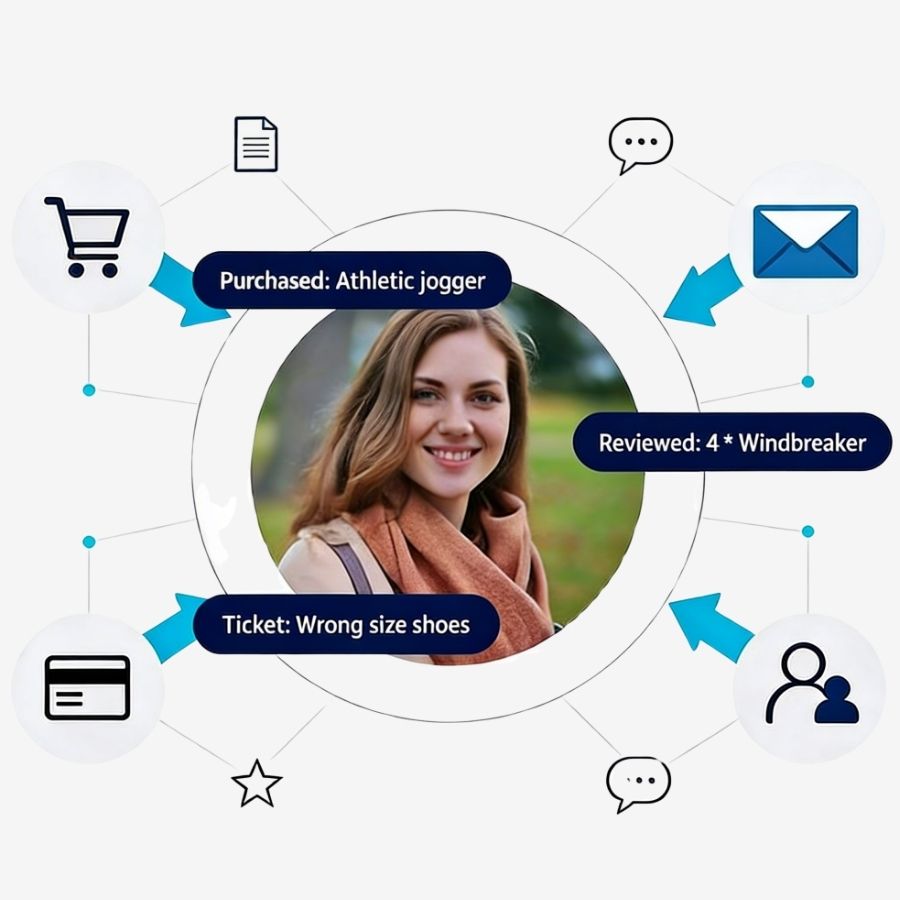
Data integration means more than storing data in one central place. It means connecting, cleaning, and structuring information across all your businesses’ systems, applications, and data sources into a unified, usable format. This unified dataset transforms fragments into full customer profiles. It reveals the journey from the first interaction to the most recent purchase. Most importantly, it provides the context that makes AI accurate and actionable.


HOW FLYDE CAN HELP

The FLYDE Customer Data Platform (CDP) is designed to solve the integration challenge and prepare data for AI-driven use cases. FLYDE connects your data sources, from marketing tools and sales systems to customer service platforms. It collects, standardizes, and combines data into complete profiles that update in real-time.

Once centralized in FLYDE, your data is no longer trapped in spreadsheets or siloed reports. It becomes AI-ready data, structured for insights and accessible across your business units.

With FLYDE you can:

  • Build a reliable single view of each customer.
  • Feed clean, structured data into AI and machine learning models.
  • Provide your marketing, sales, and operations teams with a consistent source of truth.

Once your data is unified, AI can finally do its job. Some of the most powerful opportunities include:

  • Smarter personalization: recommending the right product at the right moment, based on actual behavior patterns.
  • Leveraging predictive models: forecasting churn, customer lifetime value, or seasonal demand with confidence because the data feeding the model is complete.
  • Optimized decision-making: allocating marketing spend where it produces measurable ROI, informed by a complete customer journey.
  • Operational efficiency: reducing duplicated work and aligning teams around consistent data.


THE REAL AI MINDSET

AI is not the starting point. It is the outcome of disciplined data integration and unification. Businesses that centralize and structure their data today will be the ones leading with AI tomorrow. Without that preparation, even the most advanced algorithms will fail to deliver meaningful results.

So, if you are excited about AI, and who is not, start with the foundation. With FLYDE, you will not just join the conversation about AI. You will be ready to put it into action. Contact us to schedule a demo and we can show you the possibilities your data holds for AI implementation.


Marketing mix modeling

Marketing Mix Modeling is a statistical technique that helps marketers understand how different variables such as advertising, pricing, promotions, and seasonality impact business outcomes like sales, conversions, or revenue.

In simpler terms, MMM tells you how much each part of your marketing mix contributes to your results. It is based on historical, aggregated data, without requiring cookies or user-level tracking.


HOW DOES MMM WORK?

MMM analyzes data over time, typically at least two years, to isolate the incremental impact of each factor. It can measure both online and offline efforts such as:

  • Paid search, social, and display advertising
  • Traditional media like TV, radio, and print
  • Promotions and pricing strategies
  • Seasonality and external events like weather or competitor activity

By modeling these variables together, MMM provides attribution at the channel level and helps marketers understand the return on the investment (ROI) made in each channel.


WHY IS MMM MAKING A COMEBACK?

Marketing departments are increasingly accountable for justifying every cent they spend and demonstrating clear ROI on their activities. With budgets tightening and the deprecation of third-party cookies looming, many brands are looking back to a powerful, proven solution: Marketing Mix Modeling (MMM).

With the rise of user-level tracking via cookies and clickstream data, MMM took a back seat to multi-touch attribution (MTA). MTA is a marketing measurement model that assigns credit to multiple touchpoints along a customer’s journey to determine which channels and interactions influenced a conversion. Digital tracking, however, is facing significant obstacles due to privacy regulations. As a result MMM is becoming more relevant, because it uses aggregated data as opposed to user-level tracking, and covers both online and offline channels. 


MMM VS. MULTI-TOUCH ATTRIBUTION


Feature MMM MTA
Attribution type Top-down (channel level) Bottom-up (user level)
Data required Aggregated, historical User level, cookie-based
Works offline Yes No
Privacy compliant Yes Depends on data practices


Rather than choosing one or the other, many brands are now combining MMM and MTA. MMM provides strategic, high-level planning while MTA supports tactical, in-the-moment optimization.


HOW FLYDE FITS IN: THE ROLE OF A CUSTOMER DATA PLATFORM (CDP)

At FLYDE, we help businesses unify and activate their customer data. This includes making the most of aggregate-level signals, which is where a Customer Data Platform (CDP) plays a crucial role in enhancing MMM.

A CDP is a centralized system that collects and unifies customer data from various sources (online, offline, behavioral, transactional, demographic) into a single, comprehensive customer profile. While MMM focuses on aggregate, historical data for channel-level insights, a CDP complements this by:

  • Centralizing all marketing and sales data: A CDP acts as the single source of truth for all your customer-related data, making it easier to gather the diverse datasets needed for robust MMM. This includes data from CRM, ERP, web analytics, advertising platforms, and more.
  • Cleaning and enriching datasets for modeling: CDPs are designed to ingest, cleanse, and standardize data from disparate sources. This ensures the data fed into MMM models is accurate, consistent, and complete, leading to more reliable insights. A CDP can also enrich data with additional attributes, improving the depth of your analysis.
  • Once MMM provides insights on channel effectiveness and optimal budget allocation, a CDP can act as the bridge to activate these insights. It allows you to push segmentation and targeting recommendations derived from MMM directly to your ad platforms, email marketing tools, and CRM for more effective campaign execution.
  • While MMM works with aggregated data, a CDP can provide a richer understanding by linking these aggregate insights with more granular behavioral data. Even without cookies, techniques like navigation fingerprinting (which anonymously tracks user journeys based on browser characteristics and other non-personally identifiable information) can be ingested by a CDP. This allows for a holistic view, where broad MMM findings can be refined and informed by observed customer behaviors, enabling more precise targeting and personalization within privacy boundaries.

This means smarter planning without compromising privacy and better orchestration of omnichannel efforts, from the first anonymous visit to long-term customer retention.

Marketing Mix Modeling aligns with the marketing industry’s most predominant trends: smarter measurement, responsible data use, and data-driven channel strategies.


HOW FLYDE CAN HELP

Want to learn more about how FLYDE supports MMM and helps unlock real omnichannel impact?

Contact us to schedule a meeting to discuss how a Customer Data Platform (CDP) like FLYDE can enable you to implement MMM in your business. 


Demand Forecasting for Inventory Management

Success starts behind the scenes. While marketing, sales, and product innovation often steal the spotlight, inventory management can make or break your profitability and customer experience.

Think of your stock as a dynamic, strategic asset. Managed well, it fuels growth. Neglected, it quietly drains your resources and undermines your business.


THE COSTS OF INVENTORY MISMANAGEMENT 

Poorly managed stock has immediate and costly consequences:

THE BENEFITS OF SMART STOCK MANAGEMENT

According to the Institute for Business Forecasting, a 15% increase in inventory forecasting accuracy translates into a 3% increase in earnings before interest and tax (EBIT). Great inventory management is strategic. When done right, it delivers:

  • Increased customer satisfaction: Reliable stock availability builds trust and keeps customers coming back.

  • Reduced costs: You’ll be able to avoid surcharges for rush shipping, unnecessary storage fees, and waste from obsolete stock.

  • Better cash flow: Freeing up capital from excess inventory gives you more flexibility to invest in growing your business.

  • Efficient operations: With clear processes and real-time data, your team can move faster and make fewer mistakes.

  • Smarter decisions: Accurate inventory data allows you to make smarter, data-driven business decisions. It helps guide pricing, purchasing, and marketing based on real demand.

THE ROLE OF TECHNOLOGY

Fortunately, artificial intelligence (AI) and machine learning (ML) are transforming inventory management by enabling more accurate demand forecasting. Demand forecasting is the practice of using historical data, market trends, and advanced analytics to predict future customer demand for a product or service. It empowers businesses to make smarter decisions across inventory, production, staffing, and budgeting—ultimately reducing waste, avoiding stockouts, and improving operational efficiency.

AI/ML-powered demand forecasting delivers key advantages for inventory management, including:

  • Real-time visibility: Instantly see what’s in stock, where it is, and what needs replenishing.

  • Automation: Streamline purchasing, receiving, and fulfillment processes to boost efficiency and reduce errors.

  • Advanced analytics: Detect trends, optimize inventory levels, and identify bottlenecks or slow-moving stock.

  • System integration: Centralize data from sales, finance, and e-commerce platforms. A Customer Data Platform (CDP) like FLYDE can help unify and enrich this data for smarter forecasting.


INVENTORY MANAGEMENT HEALTH CHECKLIST

How effective is your inventory management system? If you answer “no” to several of these questions, it might be time to rethink your approach.

Data & Visibility

  • Can you see inventory levels in real time across all channels and warehouses?
  • Do you have a centralized view of customer demand trends?
  • Is your inventory data integrated with sales, marketing, and finance systems?

Forecasting & Planning

  • Are your forecasts based on historical data and real customer behavior?
  • Are your forecasting models updated regularly?
  • Can you confidently anticipate when you will encounter a spike or a lull in demand?

Efficiency & Operations

  • Is your restocking process automated (or is it manually triggered)?
  • Are fulfillment mistakes (e.g., wrong items, delayed shipments) a rare exception?
  • Do you know your inventory turnover rate?

Financial Impact

  • Are you confident that your inventory is not tying up more capital than necessary?
  • Are you able to avoid paying extra fees for expedited shipping or unnecessary storage?
  • Does your team have fast access to accurate data to make stock decisions?


HOW FLYDE CAN HELP

To accurately forecast demand and optimize inventory, a Customer Data Platform (CDP) like FLYDE is essential for consolidating data from various sources.

FLYDE centralizes data from touchpoints across paid media, CRM, social, email, web navigation, and offline events. Whether you’re working with dozens of fragmented sources or just trying to get a full view of the customer journey, FLYDE brings your data together and enriches it with socio-demographic and interaction data.  With FLYDE’s ML algorithms, you’ll be able to analyze the behavior of your customers, observe in real time how their movements affect the demand for your products, and anticipate future demand.

Contact us to schedule a demo to find out how FLYDE approaches demand forecasting in our easy-to-use Customer Data Platform.

Lead Scoring, Upgraded

You’ve assigned points to job titles, tracked email opens, and called the hot leads who ghosted. Welcome to the world of traditional lead scoring.

For years, marketers have relied on scoring models that evaluate leads based on demographics and surface-level actions like website visits or email clicks. But these models often fail to capture true buyer intent. They are based on assumptions as opposed to behavior, and they often overlook high intent leads with atypical characteristics.


THE PROBLEM WITH TRADITIONAL LEAD SCORING 

Despite being a foundational tool in marketing, traditional lead scoring has major drawbacks:

  • Inaccuracy – Based on incomplete or outdated data.

  • Subjectivity – Scoring criteria are often inconsistent or biased.

  • Lack of Scalability – Difficult to maintain effectively as lead volume grows.

  • Blind Spots – Ignores pre-identification behavior (e.g. anonymous browsing).
  •  

These models can overlook high-intent leads who don’t fit your ideal buyer persona. Let’s imagine, your sales team typically targets CEOs or other high-level decision makers. With traditional lead scoring methods, you could easily overlook a junior employee who is doing research for his/her boss, who is the CEO. 

AI-powered lead scoring, however, goes beyond assumptions, delivering real-time insights that help you prioritize the right leads, faster.

Traditional lead scoring sees behaviors. AI understands their intent.


MEET LEAD2CUSTOMER: FLYDE’S AI MODEL THAT UNDERSTANDS THE WHOLE JOURNEY

FLYDE’s platform replaces the outdated model with something smarter: Lead2Customer, our AI-powered predictive model that evaluates leads based on real behavior, not assumptions.

Unlike traditional methods that rely heavily on demographic filters, Lead2Customer looks at a rich set of behavioral signals across the entire funnel, such as:

  • Website navigation patterns (even before users identify themselves)

  • Newsletter signups

  • Email marketing open and click-through rates

  • Webinar attendance

  • Social media engagement


HOW IT WORKS

The Lead2Customer algorithm uses machine learning to calculate a dynamic conversion probability, expressed as a percentage. This means every lead in your CRM isn’t just labeled “hot” or “cold”—they’re scored in real time based on how likely they are to convert.

Unlike traditional systems in which leads are scored periodically, AI systems can adjust scores in real time as new data becomes available. This means that your sales and marketing teams can act even when a lead’s behavior suddenly changes. Imagine for example, that a lead suddenly shows new interest by attending a webinar, downloading a white paper, and visiting your pricing page all within an hour. AI doesn’t have to wait for your weekly scoring batch; it can immediately flag the lead and your sales team can reach out.

What’s more? It learns and improves over time. As your AI system observes how leads convert (or fail to), it learns to identify better indicators, continuously optimizing the scoring model to match your evolving data. This ongoing learning process is one of the most valuable aspects of AI-powered lead scoring, as it ensures that your system is always evolving to reflect changes in customer behavior, industry trends, and marketing strategies.


HOW AI-POWERED LEAD SCORING IS CHANGING THE GAME

AI-powered lead scoring methods, like Lead2Customer, enable your sales and marketing teams to work more efficiently and effectively:

  • Behavior-based scoring – Uncover high-potential leads who don’t match your typical buyer persona.

  • Full-funnel visibility – Capture both anonymous and identified user behavior.

  • Real-time adaptability – Prioritize leads based on the latest interactions.

  • Increased conversion rates – Focus on the leads that matter most, when it matters most.

  • Smarter use of resources – Don’t waste time on dead-end prospects.

  • Faster response times – Engage leads at peak interest.

  • More personalization – Tailor content and timing to the moment.


SMARTER LEAD SCORING STARTS WITH SMARTER DATA

To power AI-driven scoring, you need unified, real-time customer data. That’s where FLYDE’s Customer Data Platform (CDP) comes into play. FLYDE pulls data from every touchpoint—website interactions, email engagement, social activity, and many more—creating a centralized customer profile. This unified data layer allows AI to update lead scores dynamically across all platforms, ensuring that your marketing and sales teams are always working with the most accurate and up-to-date insights.

With FLYDE powering your lead scoring process, your team can make faster, smarter decisions, prioritize the highest-value opportunities, and ensure that every lead counts.

Contact us to schedule a demo to find out how FLYDE can help you unlock the full potential of AI to boost the success of your marketing and sales teams.

The puzzle of attribution in omnichannel marketing.

In a perfect world, a customer clicks on an ad, falls in love with your product, and converts on the spot. You know exactly which campaign worked, which channel gets credit, and where to increase your ad spend. Easy.

But we don’t live in a perfect world. The customer journey isn’t single-channel or linear. We live in the age of omnichannel marketing. The reality is that a single purchase might be influenced by a Google search, a TikTok video, a webinar, a promotional email, or a conversation with your sales team.

Attribution—figuring out which touchpoints actually matter in the buyer’s journey—is no longer simple. It’s a messy, multi-source puzzle. And without solving it, you risk spending your budget in the wrong places.

So, let’s dive in and examine what attribution really means in omnichannel marketing campaigns and what challenges we face as marketers to assign credit where credit is due.  


WHAT IS ATTRIBUTION?

At its core, attribution is about assigning credit to each step that helps take a customer from “just looking” to “just bought.”

In single-channel or linear journeys, this used to be easy. But today, marketers rely on a mix of digital and offline channels working together, which means that the process of attribution has had to evolve.

Let’s look at a few common attribution models:

  • First-touch: Gives all credit to the first interaction. If we want to focus on awareness metrics, this is a great approach, but it offers little insight in terms of conversions.  
  • Last-touch: Credits the final click before a conversion. Many platforms use this as the default model, but it represents an oversimplification of the customer journey.
  • Linear: Spreads credit evenly across all touchpoints. Here, the whole journey is taken into account, but not very strategically.
  • Time-decay: Gives more credit to recent touchpoints. This model is well-suited to long nurture cycles.
  • U-shaped (position-based): Emphasizes the first and last touchpoints, with less credit to the middle. Here, there is an emphasis on the awareness and decision stages of the funnel, but the model is apt to under-credit important engagement actions.
  • Data-driven: Uses machine learning to assign weights based on actual conversion data. This model is ideal—but requires strong data hygiene and scale.

Each model has its own advantages and its own bias. In complex, omnichannel campaigns with many different touchpoints, it becomes increasingly important to move beyond simplistic models and embrace AI-powered attribution, which can analyze massive, messy datasets and zero in on what is driving conversions.


WHY DOES ATTRIBUTION GET COMPLICATED IN OMNICHANNEL CAMPAIGNS?

In the world of omnichannel marketing, the customer journey rarely follows a predictable path. The customer journey nowadays is non-linear, fragmented, and often, a portion of the journey is undertaken while the user is still anonymous.

Here’s why attribution is so tricky today:

  • Device-hopping behavior: Your lead might see an Instagram ad on a mobile, Google your product on a laptop, and sign up for your newsletter from a desktop at work. The right tracking set-up is essential for connecting the dots.

  • Walled gardens: Platforms like Meta, Google, and Amazon often don’t share data with each other—or with you! In these cases, each platform may allow advertising and data analysis within its own ecosystem using proprietary attribution and tracking methods, while limiting access to raw data for export to other platforms.

  • Offline influences: Sales calls, print materials, events, or word-of-mouth are all powerful but hard to track.

  • Privacy regulations: With the deprecation of third-party cookies and tighter data regulations, user-level tracking is more limited, making granular attribution even more challenging.

The result? A lot of guesswork and misallocated spending.

HOW TO IMPLEMENT ATTRIBUTION STRATEGIES FOR OMNICHANNEL MARKETING CAMPAIGNS 

The key to approaching attribution for omnichannel marketing is to stop aiming for perfect attribution—and start aiming for actionable insight.

Here’s how to get started:

  1. Unify your tracking setup:
    • Implement clean, consistent UTM parameters
    • Your CRM and ad platforms must be connected. A Customer Data Platform (CDP) like FLYDE can bring it all together (more on that later)

  2. Invest in smarter analytics:
    • Develop funnel-based dashboards tied to your KPIs
    • Implement machine learning models if your data volume allows

  3. Set realistic expectations:
    • Attribution will never be 100% accurate
    • Focus on directional insight that can inform your strategic decisions
    • Align attribution analysis to business outcomes (not just clicks)

Instead of chasing perfection, chase progress. Map the journeys, unify the data, and use a tool like FLYDE to reveal insight. The goal isn’t to give perfect credit; it’s to make smarter, more confident decisions.


FLYDE’S VISION ON SMARTER ATTRIBUTION 

To address these omnichannel challenges and the need for a unified view, a Customer Data Platform (CDP) like FLYDE becomes essential for consolidating data from various sources.

FLYDE centralizes data from touchpoints across paid media, CRM, social, email, web navigation, and offline events. Whether you’re working with dozens of fragmented sources or just trying to get a full view of the customer journey, FLYDE brings your data together to offer clarity and insight.

Here’s a real-world example:

Imagine you run a lead-gen campaign using a CPC paid search campaign in Google, Meta ads, a product webinar, and follow-up email flows. With FLYDE:

  • All touchpoints are stitched together—even across platforms.
  • You can see how many leads saw an ad and attended the webinar.
  • You can compare performance across acquisition and nurture phases.
  • Attribution is based on your journey logic, not just Google’s last-click default.

This kind of transparency doesn’t just look good in reports—it drives better decision-making. When you know what’s working, you can double down. When something’s underperforming, you can pivot fast. Ultimately, effective attribution leads to optimized advertising spend, a deeper understanding of customer behavior, and improved ROI.

Contact us for a demo and we can show you how FLYDE approaches omnichannel attribution in our easy-to-use Customer Data Platform.